The AI art debate is not really about whether machines can make beautiful things. It is about whether beauty still counts when nobody paid a premium for the labor behind it.
We say we want artists to be paid. We also expect every café, charity, podcast, side business, apartment building, wedding, and neighborhood event to arrive with the polish of a global brand. Those desires sound compatible until the invoice arrives.
The conflict is not that people stopped caring about beauty. It is that our expectations for beauty have expanded faster than our willingness—or ability—to pay for the labor required to produce it.
The expanding job description of beauty
Photography is an unusually clear example.
The center of the job used to be the photograph: light, timing, composition, expression, and the judgment to recognize the right frame. Those skills still matter, but the modern deliverable often extends far beyond them.
A photographer may now be expected to shoot stills and video, retouch images, color-grade footage, select music, cut vertical clips, add captions and transitions, export several platform-specific versions, design a flyer, interpret a brand, recommend a campaign direction, and manage repeated rounds of subjective feedback. The word photographer has become a compressed label for a small media department.
The price rises because the surface area of the job rises. A client sees a four-hour shoot. The professional sees preparation, equipment, travel, file management, editing, revisions, licensing, delivery, and the opportunity cost of a week that can no longer be sold to someone else.
This is not greed. It is scope.
But scope has a cultural consequence. The more responsibilities we attach to a craft, the less accessible that craft becomes. The photographer has to charge enough to survive the expanded job. The small business looks at the bill and decides it cannot participate.
Then AI appears.
The moralization of the budget
For a large company, replacing a paid creative team with generative software may be straightforward labor substitution. The company had the money, employed the people, and chose to increase its margins.
For a neighborhood bakery, a volunteer organization, or a two-person startup, the alternative may never have been a $5,000 campaign. It may have been a homemade Canva graphic, a phone photo, or no campaign at all.
That distinction matters. Not every generated image represents a commission stolen from an artist. Sometimes automation creates access to a capability that the buyer could not previously afford.
“Pay artists” remains a good principle. Artists should not be deceived, exploited, impersonated, or expected to work for exposure. Training-data provenance and labor displacement are real problems. But the principle becomes stranger when it turns into a demand that anyone unable to afford professional creative labor must accept looking amateur.
At that point, the ethical claim starts to function as a class boundary: visual sophistication is legitimate only when someone can prove they purchased enough human labor.
Automation can democratize production and devalue skilled work at the same time. Both facts can be true. The harder question is who should bear the cost of preserving the old price of beauty.
The five-over-one is an answer
Housing reveals the same mechanism at a larger scale.
People want homes that are affordable, safe, accessible, energy-efficient, locally appropriate, architecturally distinctive, built from durable materials, close to amenities, and created without disrupting existing residents. Every item on that list can be defended. Together, they create a long chain of approvals, specialist work, financing risk, coordination costs, and delay.
Those costs do not disappear because the goals are admirable. They accumulate inside the final price.
A 2024 UHERO analysis of condominium construction in Hawai‘i estimated that “regulatory costs”—defined broadly as the gap between sale price and land, materials, and labor, including fees, restrictions, developer profits, and permitting delays—accounted for 58 percent of the median price of a new two-bedroom unit. That number should not be treated as universal, and the report explicitly recognizes that regulations can produce real public benefits. Its value is in making the tradeoff visible: every desirable constraint still has to be paid for somewhere.
The familiar five-over-one apartment building is another visible tradeoff. Repetitive floor plans, standardized materials, wood framing over a concrete podium, and familiar construction methods make the project easier to price, finance, approve, and build. The result is often criticized as bland, disposable, or copied from everywhere else.
Sometimes that criticism is deserved. Standardization can become laziness. Cheap materials can age badly. A building can satisfy a spreadsheet while failing the street.
But the five-over-one is not simply evidence that developers forgot beauty exists. It is an answer produced by a system in which novelty is expensive and delay is dangerous. We ask for a bespoke outcome while preserving the economics of mass production, then blame the building for revealing the compromise.
An AI-generated flyer and a five-over-one apartment building are answers to the same constraint: people expect more aesthetic polish than most budgets can buy.
What “slop” actually describes
The word slop has become useful because it names a real experience. Generative systems can produce an endless supply of images, videos, text, and music with almost no friction. Most of it arrives without purpose, context, restraint, or consequence. It fills a feed because it can.
But slop is not merely the absence of human labor. It is abundance without judgment.
Humans make slop. Machines can execute good decisions. The important questions are whether someone cared enough to choose, whether the work belongs in its context, whether it solves a real problem, and whether anyone remains accountable for the result.
A synthetic image posted into an infinite feed costs almost nothing to make and asks for another piece of our attention. A robotically carved façade, shaded walkway, mosaic courtyard, or public bench changes a place people inhabit every day. The same production technology can feel disposable in one context and generous in another.
Physical consequence changes the argument.
When automation leaves the screen
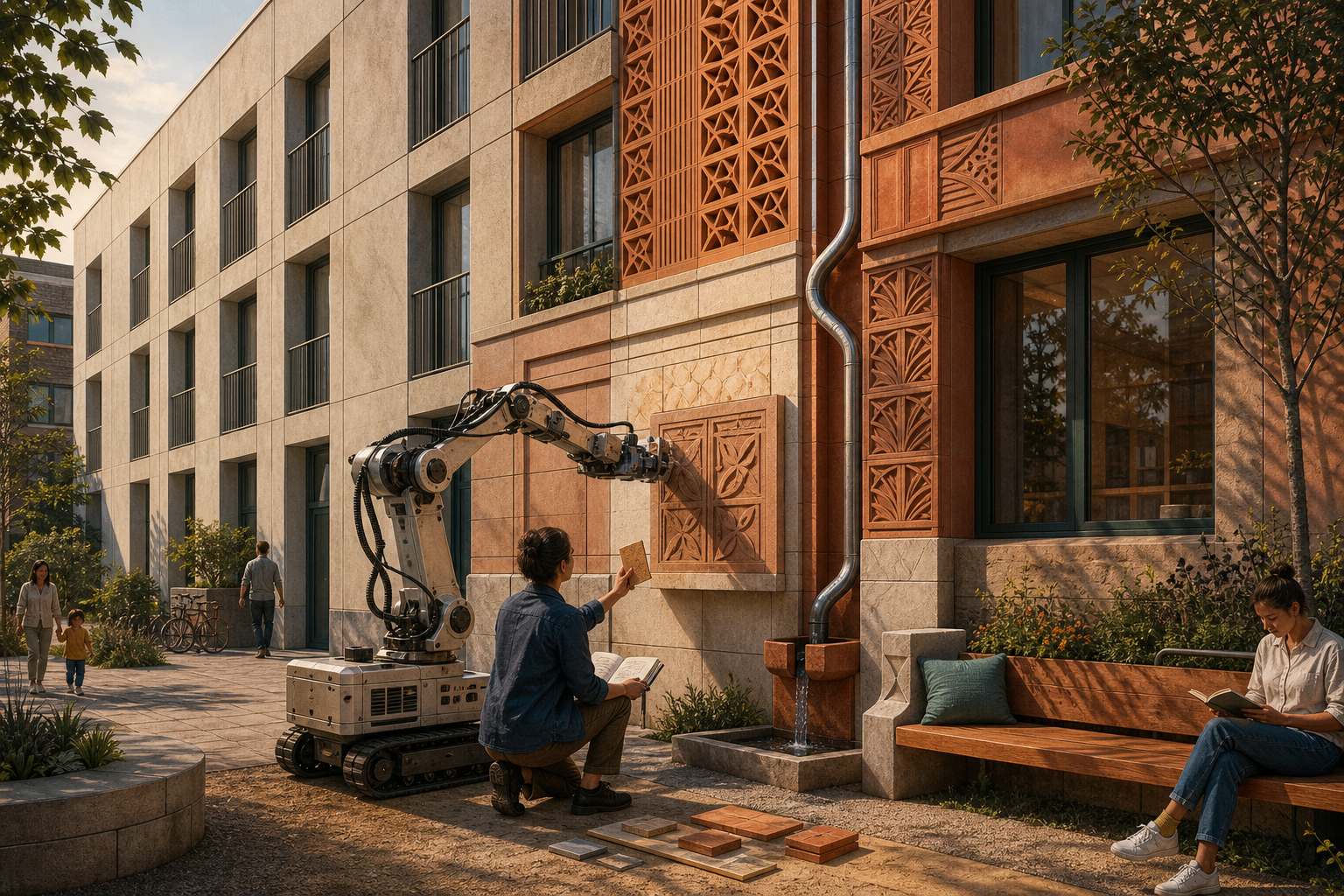
A robotic stone-carving system is a preview of what happens next.
Digital fabrication has already moved well beyond miniature prototypes. Researchers have demonstrated mobile robotic fabrication at architectural scale and modeled cooperative robotic methods for constructing scaffold-free masonry arches. The trajectory is clear even if the tools remain early: more of the cost of complex physical form can move from repetitive execution into design, setup, supervision, and machine time.
Imagine an affordable apartment building with deeply shaded windows, carved local motifs, sculptural drainage, patterned masonry, and a courtyard designed as carefully as the lobby of a luxury hotel. Suppose robots made those details economical. The residents enjoy them. The street is better because they exist. Children grow up seeing ornament and craft-like complexity as ordinary features of their neighborhood rather than privileges reserved for museums, resorts, and old banks.
Would the building become less beautiful once someone disclosed that machines executed the ornament?
Some objections would still be serious. Automated decoration could flatten local traditions into generic historical cosplay. A developer could cover a bad building in algorithmic frosting. Cheap complexity could encourage visual noise. The machines could concentrate power in a handful of vendors, displace trades without creating a path for workers, or reproduce motifs whose cultural meaning no one involved understands.
Those are arguments about ownership, governance, taste, and accountability. They are not proof that machine-made beauty is inherently fraudulent.
Automation does not eliminate the need for human judgment. It makes judgment the bottleneck.
When every surface can be decorated, restraint becomes more important. Someone still has to decide which forms belong, which histories deserve reference, which details will weather well, which patterns help people orient themselves, and when a blank wall is better than an ornate one. Taste is not the residue left after labor disappears. It becomes the scarce input.
Beauty, craft, authenticity, and status
Much of the argument stays confused because several different values are treated as though they were one.
Beauty is the experience of the thing. Craft is the skill embodied in making it. Authorship is the source of the consequential decisions. Authenticity is whether the object tells the truth about its origin. Status is what owning or commissioning it communicates about the buyer.
A machine-made object can be beautiful without being handcrafted. A handcrafted object can be ugly. A human can author a design that a robot executes. An automated work can be authentic if its provenance is honestly described. A mediocre object can become prestigious because it is scarce.
Once automation makes intricacy cheap, the status hierarchy will simply move. Documented handwork, visible irregularity, rare materials, named craftspeople, and limited production will become more valuable precisely because machine-made polish is common.
This has happened before. Industrial production made smooth regularity cheap, so handmade imperfection became a luxury signal. Photography made realistic representation abundant, so painting moved toward other forms of value. Digital typography made technically perfect lettering ordinary, so hand lettering became artisanal.
Automation may democratize beauty without democratizing status. Wealthy patrons will still buy the hand-chiseled façade. The difference is that everyone else may no longer be sentenced to the blank wall.
That is only a tragedy if the real goal was not beauty, but the preservation of beauty as evidence of wealth.
Beauty as infrastructure
A society can preserve human craft without requiring ordinary people to go without beauty.
It can fund apprenticeships, public commissions, preservation programs, artist residencies, transparent provenance, and premium markets for genuinely handmade work. It can protect workers during technological transitions and insist that automated systems do not disguise themselves as human labor. It can value the maker without making scarcity the maker’s only business model.
The alternative is to treat ugliness as an ethical obligation for anyone with a small budget.
Beauty is not frivolous simply because it is difficult to price. It shapes attachment, dignity, memory, and the feeling that a place or object was made for human beings rather than merely processed around them. Those benefits should not belong only to people who can afford bespoke labor.
The question is not whether machines can make beautiful things.
It is whether we will allow beauty to become common once it no longer proves that someone could afford scarcity.